
AI transformation is a problem of governance — not a problem of technology. Most enterprise AI projects in 2026 are not failing because the models are too weak or the cloud infrastructure is not powerful enough. They are failing because nobody clearly owns the risk, nobody has authority to approve changes, and nobody answers when something goes wrong.
That is the uncomfortable truth. And the data backs it up completely. The reason this conversation keeps surfacing in boardrooms, in regulatory hearings, and in enterprise post-mortems is simple: AI transformation is a problem of governance in every sector, not just regulated ones. Stop treating it as an IT project. Start treating it as a leadership responsibility.
The Real Scale of AI Failure in 2026
Before talking about fixes, look at what is actually happening right now.
Global enterprise AI spending in 2026 will reach $665 billion. Yet approximately 73% of those deployments will not deliver the projected return on investment. This is not an edge case — it is the most common outcome of enterprise AI investment.
An S&P Global survey of more than 1,000 companies found that the share of firms abandoning AI initiatives jumped from 17% to 42% in a single year. The failure rate more than doubled in twelve months. MIT’s GenAI Divide Report tracked $30–40 billion in enterprise generative AI spending and found that only 5% of projects produced measurable P&L impact. Deloitte’s 2026 State of AI in the Enterprise Report, based on 3,235 senior executives, revealed that only 1% of businesses consider themselves AI-mature and only 34% have genuinely rebuilt their operations around the technology. You can review Deloitte’s full AI governance research for the complete dataset.
These are not findings from skeptics. They are the consensus conclusions of the most rigorous enterprise research available. AI transformation is a problem of governance. The models work. The organizations around them do not.
| Stage | % of Organizations | What This Means |
|---|---|---|
| Companies Investing in AI | 100% | Baseline — all firms with active AI spend |
| Delivering Projected ROI | 27% | 73% fail to meet projected returns |
| Moved Beyond Pilot Phase | 22% | Most AI stays in pilot — governance gap kills scale |
| Created Substantial Value | 4% | Only 4% of companies see measurable P&L impact |
| Considered AI-Mature | 1% | Deloitte 2026: only 1% have rebuilt operations around AI |
What “Governance” Actually Means Here — and What It Does Not
The word governance gets used loosely, and that vagueness is itself part of the problem.
AI governance is not a PDF document sitting in the compliance folder. It is not an annual committee meeting reviewing a risk register. It is not a checklist to tick before pitching an AI idea to the board.
Real governance is the system that can answer four questions — at scale, in real time, for every AI system your organization runs:
- Who is authorized to operate this model?
- Who carries the risk if it fails?
- Who approves changes?
- Who is accountable when it causes harm?
If your organization cannot give clear, documented, and enforceable answers to those four questions for every live AI system, you do not have governance. You have the appearance of governance. That appearance collapses the moment something goes wrong — which, for AI systems shaping pricing, hiring, credit, customer service, and financial decisions, is a matter of when, not if.
Until those four questions have real answers, AI transformation is a problem of governance by default, regardless of how advanced the underlying models are. Strong governance defines accountability before deployment. Weak governance reveals accountability gaps after an incident. No governance means there is no accountability at all — just a chain of people looking at each other while regulators start writing.
IBM’s framework for AI governance defines it as the set of policies, processes, and guardrails ensuring AI systems remain safe, ethical, and aligned with human rights — a definition that closely mirrors what enterprise risk teams are now implementing under real regulatory pressure.
The Leadership Accountability Gap Nobody Talks About
The governance failure starts at the top. The numbers make that clear.
McKinsey found that only 28% of CEOs have direct responsibility for AI governance. Only 17% of board directors formally own it. The NACD’s 2025 board survey found that while most boards now discuss AI regularly, only 27% have embedded AI governance into committee charters.
In practical terms: AI systems are influencing pricing, credit approvals, and hiring decisions inside companies where roughly four in five enterprises have no clear executive accountable for what those systems actually do.
Deloitte’s survey of 700 board directors and executives across 56 countries found that 66% of boards report limited or no AI expertise. Only 14% discuss AI at every board meeting — even when AI-driven processes run continuously inside their businesses.
When boards are not accountable, accountability gets diluted. When accountability is diluted, nobody owns what AI does after deployment. When nobody owns the risk, it compounds quietly until it surfaces as a crisis. This is the structural proof that AI transformation is a problem of governance — not a problem of engineering, tooling, or computing power. AI risk is leadership risk. Every downstream failure — model drift, data integrity issues, regulatory exposure, wasted ROI — traces back to the fact that executive accountability was never defined in the first place.
When boards lack both expertise and clear accountability for AI, AI transformation is a problem of governance that starts at the very top of the organization.
Why AI Transformation Specifically Breaks at the Governance Layer
Getting a model into production is not the challenge. The breakdown happens around who controls it, how it is monitored, and what the escalation path looks like when it misbehaves.
Typical failure patterns across organizations look the same:
- No single owner for AI outcomes at the enterprise level.
- Data, product, risk, and compliance teams cannot agree on who approves changes.
- No defined threshold for when a human must review or override an AI decision.
- Leadership receives polished AI updates but never sees structured risk reporting.
AI quietly reshapes who has influence and how decisions get made. If your governance structure still assumes humans are in control, but algorithms are now silently shaping credit approvals, insurance pricing, candidate shortlists, or medical triage flags — that is a real shift in organizational power with no matching shift in accountability.
Every one of those patterns confirms the same diagnosis: AI transformation is a problem of governance that technology investment alone cannot solve. That is the main reason so many successful-looking pilots never become enterprise transformation. Governance simply does not scale with the technology.
What Global Governments Are Learning the Hard Way
This governance failure is not just an internal business problem. It has become a foreign policy and regulatory issue at the highest levels.
A May 2026 analysis published in Foreign Policy by Sarosh Nagar and David Eaves identified a striking paradox: most countries are calling for international AI coordination, yet concrete international action on AI governance remains almost entirely absent. The Seoul AI Summit commitments remain voluntary. Enforcement has been inconsistent. Global governance debates remain highly fractured.
The reason, as Nagar and Eaves argue, is not purely political. It is epistemic. Countries fundamentally disagree on what AI is, how fast it is advancing, and how self-sufficient they are in controlling it. If governments cannot agree on what they are governing, they cannot coordinate on how to govern it.
A peer-reviewed study published in Nature’s Humanities and Social Sciences journal confirms this pattern, finding that the combination of limited technical capabilities and regulatory urgency has produced inertia across most jurisdictions — governments want to act but cannot agree on the target.
This matters for boards and executives because it means external regulation alone will not protect you. International governance frameworks are advancing too slowly and too inconsistently to substitute for internal organizational governance. The companies and institutions waiting for regulators to define the rules before building their own accountability structures will be perpetually behind — and perpetually exposed.

The Five Core Pillars of Governance That Actually Work
The organizations that have started solving the fact that AI transformation is a problem of governance tend to operate around five consistent pillars. Here is what they look like in practice.
1. Clear Ownership and Decision Rights
There is no accountability without clear ownership. Assign a specific executive or establish a formal AI council with enterprise-level authority. Define who can approve new AI use cases and who can block deployment. Spell out who must sign off on high-risk rollouts and who can authorize a rollback. If a critical system fails, there should be zero confusion about who was responsible.
2. Data Governance and Integrity
Every AI initiative rises or falls on data quality. Governance must clearly answer: Who owns which datasets? Who grants and revokes access? How is data lineage documented end-to-end? Bad governance at the data layer guarantees bad outputs at the model layer, regardless of algorithm quality.
3. Model Lifecycle Oversight
Models need governance across their entire life — from development standards and independent validation to controlled deployment, change logging, ongoing monitoring for drift, and defined criteria for retraining or retiring. Without this, systems that performed perfectly in testing gradually diverge from reality, and nobody notices until real harm has already occurred.
4. Risk and Compliance Architecture
AI risk is multidimensional: legal exposure, ethical and fairness concerns, security vulnerabilities, operational resilience, financial impact. Governance means embedding AI formally into the enterprise risk framework — not managing it as a side project. Risk committees need AI on their dashboards every week, not only when someone submits a project proposal.
5. Human Oversight and Escalation Playbooks
“Human-in-the-loop” is not a slogan — it is a set of defined rules. Which decisions must always have a human review? At what thresholds does human authorization become mandatory? How quickly can staff pause or override a system going sideways? Escalation paths must exist before a crisis forces you to invent them under pressure.
The AI Governance Maturity Ladder: Where Is Your Organization?
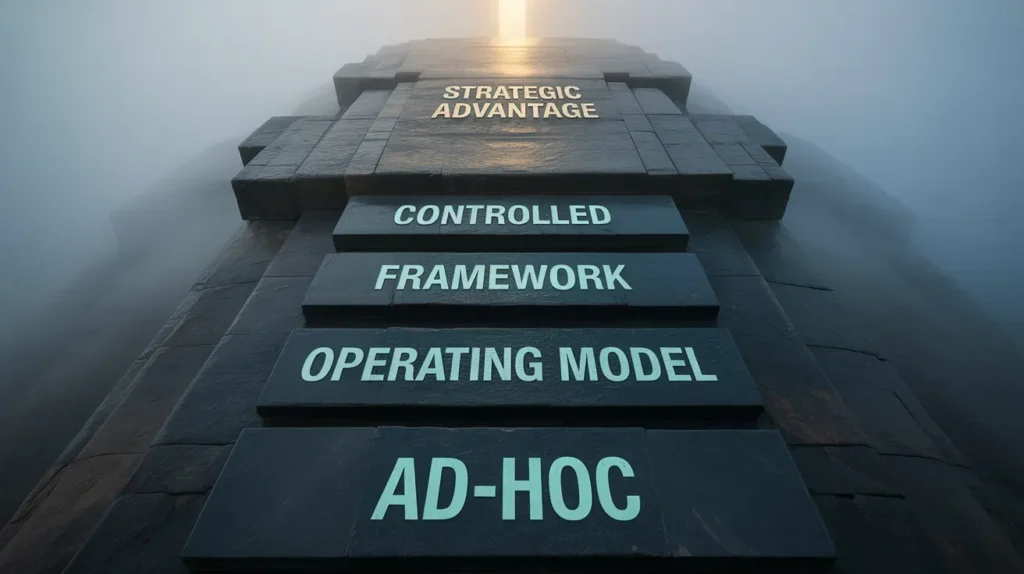
A simple way for boards to see where they stand on the core issue — that AI transformation is a problem of governance — is to map the organization against a five-level maturity ladder:
Level 1 — Ad-Hoc Experiments
Pilots run in isolated pockets. No documentation, no central oversight, no shared standards.
Level 2 — Controlled Proofs-of-Concept
Some guardrails exist, but each business unit builds its own. Fragmented and inconsistent.
Level 3 — Formal Governance Framework
Policies, principles, and roles are documented. Adoption is uneven across the organization.
Level 4 — Enterprise AI Operating Model
Governance is integrated across departments with shared tools, repeatable processes, and consistent reporting.
Level 5 — Governance as Strategic Advantage
Strong governance becomes a trust signal. Customers, regulators, and partners actively choose to work with you because of how responsibly you operate AI.
| Maturity Level | % of Organizations | Description |
|---|---|---|
| Level 1: Ad-Hoc | 18% | Pilots run in isolated pockets, no shared standards |
| Level 2: Controlled POC | 34% | Some guardrails, fragmented across business units |
| Level 3: Formal Framework | 29% | Policies documented but adoption uneven |
| Level 4: Enterprise Model | 14% | Governance integrated across departments |
| Level 5: Strategic Advantage | 5% | Governance as a trust signal and competitive advantage |
Most organizations in 2026 sit between levels 2 and 3. The objective is not to jump to level 5 overnight. It is to move up the ladder deliberately, with clear priorities at each step.
From “Can We Build It?” to “Should We Deploy It?”
Until recently, the dominant AI question was “Can we build this?” With today’s open models and APIs, the technical answer is almost always yes.
The critical strategic question has shifted: “Should we use it, and under what conditions?”
If AI transformation is a problem of governance, then leadership must face explicit trade-offs:
- Accuracy vs. fairness.
- Speed vs. oversight.
- Full automation vs. human intervention.
- Innovation vs. regulatory risk.
Mature governance does not slow organizations down by default. Most of the time it actually accelerates delivery — because approval paths are predictable, risks are mapped, monitoring is running, and everyone trusts the process. Good governance is not the brake. It is the steering wheel and the guardrail that lets you move faster with confidence.
A Practical Roadmap for Boards and Executives in 2026
If AI transformation is a problem of governance, the practical question for leadership is: where do we start? The OECD’s 2025 report on governing with artificial intelligence documents 200 real-world government AI deployments and consistently highlights the same enablers — oversight, accountability, and structured engagement — that enterprise governance frameworks need. Here is a pragmatic roadmap:
- Set your AI vision and risk appetite. Define which use cases you will pursue, which you will avoid, and how much risk is acceptable in each domain.
- Assign senior accountability with real authority. Name a specific executive or council. Ensure direct visibility across business units and collaboration channels with risk, legal, compliance, security, and operations.
- Conduct an honest AI inventory. Document every model, tool, and automated system currently in use. Classify each by risk level: low, medium, high, critical.
- Establish data and model governance standards. Define requirements for data quality, access control, model development, validation, monitoring, and retirement.
- Embed AI into enterprise risk and compliance reporting. Make AI a standing item in risk registers, audit plans, and board-level dashboards — not a guest appearance.
- Build monitoring and escalation playbooks. Set up alerts and dashboards for high-priority systems. Document who does what when something goes wrong — before it goes wrong.
- Invest in education at the board and executive level. Governance cannot function if the people accountable for it do not understand what they are governing. Boards need structured AI literacy, not just occasional briefings.
Treat this as a living operating capability, not a one-time compliance project.
Frequently Asked Questions
What does it really mean that AI transformation is a problem of governance?
It means that AI transformation is a problem of governance at its core — most failures trace back to missing ownership, unclear decision rights, and the absence of accountability structures that define who controls AI systems, who monitors their risks, and who answers when something goes wrong. It is not a technology deficiency. It is an organizational and leadership deficiency.
Is this only relevant for large enterprises or regulated industries?
No. Financial services and healthcare feel the regulatory pressure first, but any organization using AI to make pricing, hiring, recommendation, or customer-facing decisions faces the same governance challenges. Trust, operational risk, and accountability gaps exist in every sector and at every company size.
Can we just buy a governance platform or tool to fix this?
Tools genuinely help with logging, monitoring, documentation, and alerts. But they cannot substitute for leadership decisions about risk appetite, ownership, and organizational accountability. AI transformation is a problem of governance primarily because of how organizations are structured and led — not because of missing software.
Why do so many AI projects pass the pilot stage but fail to scale?
Because pilots are small, controlled, and supervised. Scaling requires consistent data standards across multiple departments, defined ownership when models touch multiple business units, and board-level visibility into risk and performance. When governance was never built for scale, scaling fails. Every time.
Who should own AI governance inside the organization?
Effective organizations assign a named senior executive — often a CIO, CDO, CRO, or dedicated Chief AI Officer — supported by a cross-functional committee that includes risk, legal, compliance, security, and key business leaders. Governance by committee without a named owner produces diffused accountability, which is the same problem it is trying to solve.
How is AI governance different from traditional IT governance?
Traditional IT governance focused on system availability, data protection, and security. AI governance adds fundamentally different challenges: models that evolve and drift, probabilistic outputs, bias and fairness concerns, explainability requirements, and autonomous decision-making at a scale that traditional controls were never designed to handle.
Does building strong governance actually slow down AI innovation?
When implemented as bureaucracy, yes. When designed intelligently, it usually accelerates innovation. Organizations with mature governance move faster because approval paths are clear, risk criteria are defined, and everyone trusts the process. The companies moving slowest are typically those that skipped governance early and are now rebuilding trust after an incident.
What is the single most important first step if we have almost no governance today?
Start with an honest inventory. Map where AI is already making or influencing decisions inside your organization. Identify who currently owns each system informally. Even a basic list of systems, decision types, and ownership gaps will reveal your highest priorities and give you a foundation to build from.
How does global regulatory fragmentation affect what individual organizations should do?
It means organizations cannot wait for international consensus before building internal governance. Global frameworks are advancing too slowly and inconsistently to serve as a substitute for enterprise-level accountability structures. Build internal governance now, design it to be adaptable across jurisdictions, and treat regulatory compliance as a minimum floor — not the ceiling.
What separates organizations that successfully scale AI from those that stay stuck in pilot mode?
The ones that scale have one thing in common: they treated AI transformation is a problem of governance before it became a crisis, not after. They named owners, defined risk thresholds, built monitoring infrastructure, and reported AI performance at the board level from the beginning. The ones stuck in pilot mode are still searching for better models to solve what is actually a leadership problem.
For governance specifically applied to AI-driven trading systems and algorithmic crypto bots, see the companion guide: 5 Ways AI Transformation Is a Problem of Governance in 2026 — For Crypto Traders